

Every city has some places that are especially loved by local residents. There are many of them in Birmingham. Winterbourne House and Gardens has been attracting visitors for decades with its sophistication and beauty at any time of the year. Learn more at birminghamname.
Family nest in the Arts and Crafts style
At the beginning of the 20th century, a young couple, John Nettlefold and Margaret Chamberlain, decided to build a recreational family estate. They hired local architect Joseph Lancaster Ball, who had already built several gorgeous shops and offices in the centre of Birmingham. Being a great admirer of Gertrude Jekyll, Margaret was engaged in landscape design. Gertrude was a perfect gardener and wrote several gardening advice books. The amazing Winterbourne House and a fabulous Garden were accomplished in 1903. It still remains an example of architectural and landscape art and a great place for walks.
Initially, the estate was designed as a country villa with outbuildings and gardens in the revolutionary Arts and Crafts style of the beginning of the 20th century. Its main idea was the revival of mediaeval aesthetics, opposing the Victorian court style and industrialisation. The style accepted everything unique and beautiful, everything that was created not by a machine, but by a creative person. The interior decoration, plasterboard, rosettes and French doors were made by George Bankart, a successful Birmingham craftsman.
Winterbourne House
The house featured advanced technologies for that time. It had electric lighting, plumbing, hot water and a telephone line. All the rooms looked bright and spacious. It was facilitated by high ceilings, pastel-coloured walls and fairly wide windows, letting in as much natural light as possible. All the windows overviewed different parts of the garden. Building materials were specially made by local craftsmen, so the handmade quality was felt everywhere in the house. Plaster panels were decorated with rose forms. Next to the fireplace, there was an elegant ornament of vines with ripe berries. The living room featured leaves, paradise apples and birds. The nursery was decorated mainly with small animals, such as squirrels and hedgehogs.
The happy family mostly spent the summer months at the estate, but it was a tradition to get there together at Christmas, decorate the tree and play pool. The bookcase was deliberately built into the wall to make it part of the house. The designers thought everything through carefully and not a single element of decor and furniture was superfluous.
The couple and their children spent many happy days in their country residence. However, in 1919, John Nettlefold got seriously ill and had to sell the estate in order to move closer to the hospital. Subsequent owners changed the interior according to their preferences but generally adhered to the original simplicity and elegance.
Winterbourne Garden
Gardening was also accomplished in the Arts and Crafts style. Therefore, plant compositions created an atmosphere of exclusivity, where simplicity emphasised elegance. According to Gertrude Jekyll’s philosophy, decorative and practical areas should be located side by side. Thus, the garden will be a place of rest and recreation for its caretakers. Margaret managed to create an atmosphere of comfort, complete serenity and peace.
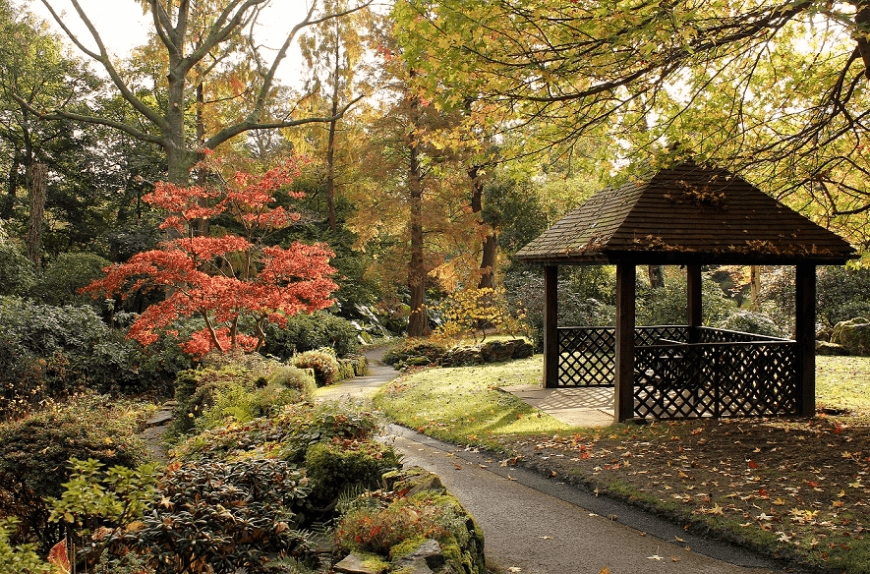
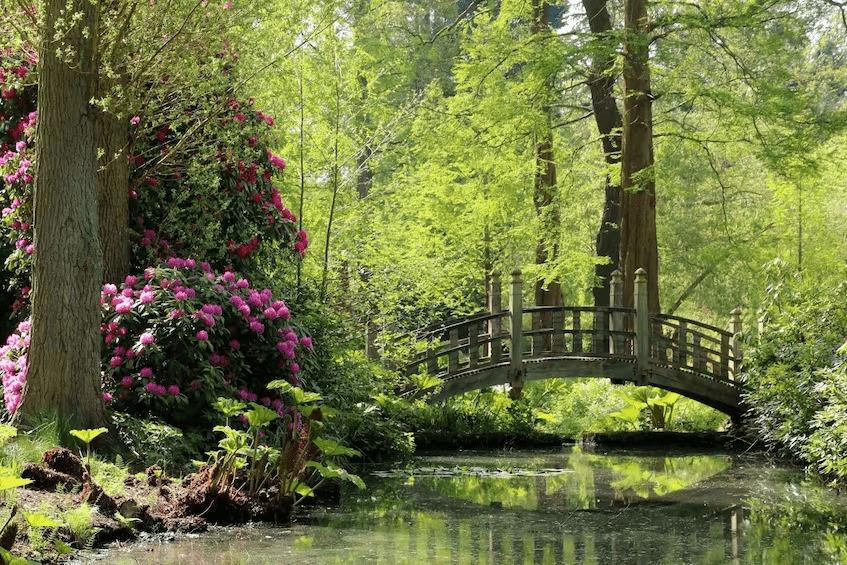
The terrace and front staircase were intended as a transitional space between the residence and nature. Therefore, decorative plants in large and small pots were placed on them. The stairs have been made rounded and they lead directly to the lawn. It was often used for picnics and croquet. In 1930, the following owners of the estate built a pergola on the large lawn, which also corresponded to the Arts and Crafts style. It makes you feel comfortable even under the scorching sun because curly plants create shade. The new owners also built a Japanese bridge and a tea house.
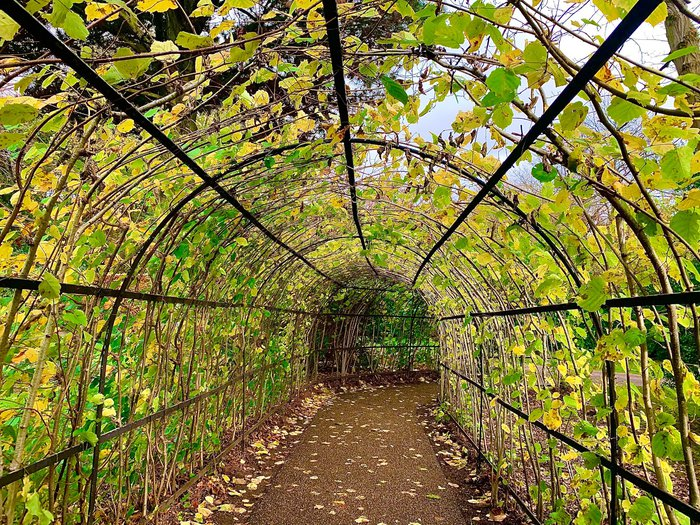
The garden and the path to the pool are separated by a gate. They are a decorative detail that combines an element of the interior and exterior. Another gorgeous element is the tunnel-shaped nut walk, which encourages meditative walks and reveals its practical side in autumn in the form of tasty hazelnuts.
There is a well in the centre of the garden so that the gardener can water it in time. A separate area of the garden was adapted for growing vegetables and fruits.
The last owner of the estate was John Macdonald Nicolson. Gardening was the most important thing in his life. He arranged new areas, adding alpine elements around the main garden and vertical wall landscaping. A philanthropist, John Nicolson bequeathed the estate to the University of Birmingham in 1944. Since then, there have been special study areas, where students conducted research aimed at preserving plants.
The location is open for visits throughout the year. The Winterbourne House and Garden hosts exhibitions, master classes on gardening and meetings of landscape design connoisseurs. The restored Winterbourne estate was Grade II listed in 2008.