

Keith Henry Stockman Campbell began studying embryo growth and cell differentiation in the twentieth century in the United Kingdom. In 1995, Campbell and his scientific team first used cells cultured and differentiated in the laboratory to clone sheep. They named these two sheep Megan and Morag. Campbell and his team also cloned a sheep from adult cells in 1996, which they named Dolly. Dolly was the first mammal cloned from specialized adult (somatic) cells using a technique called nuclear transfer. Campbell helped develop cloning methods that used a common type of connective tissue cell (fibroblasts). In addition to his work at the Roslin Institute in Edinburgh, Scotland, for much of his career, Campbell also taught at the University of Nottingham in England. Read more about the scientist’s life and work at birminghamname.com.
Childhood and Education

Keith Henry Campbell was born on May 23, 1954, in Birmingham, to Marjorie Regina Smith Campbell and Henry Stockman Campbell. He had a younger brother and sister. At age three, Campbell and his family moved to Perth, Scotland, where he began his formal education. His mother noted that he was inquisitive and adventurous. He loved nature walks, and she often had to sweep frogs out of the family kitchen after Campbell brought them home. Keith later returned to Birmingham with his family when he was eight years old. He remained in the city until he was twenty-one. The young man attended King Edward VI Grammar School for Boys on a scholarship, though he didn’t earn top grades.
He later said he disliked the school’s atmosphere. So, in 1973, at age nineteen, he passed a professional exam that qualified him as a medical laboratory technician. Campbell worked at Selly Oak Hospital in Birmingham. He then enrolled at Queen Elizabeth College in London to study microbiology. The young man quit his hospital job the same day he received his national certificate in medical technology. The certificate qualified Campbell as a medical technologist.
In 1980, Campbell began his PhD dissertation at the Marie Curie Institute in Oxted. He joined a group led by Nutan Bishun, which studied chromosomal structures in cells. Bishun had to leave the project due to illness shortly after Campbell joined, leaving Campbell without a mentor. Campbell then worked alone on his doctoral dissertation for six months until 1983.
Beginning of Scientific Activity
After earning his PhD, Campbell returned to Scotland. He said he enjoyed mountain biking, hiking, and nature walks, and felt Scotland was a place where he could enjoy these activities and pursue his chosen career. He became a research fellow in the Department of Zoology at the University of Edinburgh. Campbell joined a group led by Peter Fantes. The group worked on the cell cycle control of Schizosaccharomyces pombe, a species of yeast that reproduces by fission. In Edinburgh, Campbell met Murdoch Mitchison, who worked in cell biology and had developed fission yeast as a model system for studying the cell cycle.
In 1989, the scientist left his job in Edinburgh and started another, having received a fellowship at the University of Dundee. There, he worked again with Hutchinson on frog embryo development. In his research on frog embryos, Campbell studied cell nuclei and began to hypothesize about the ability to reprogram an already determined cell. In 1991, the scientist saw a job posting for a research scientist position at the Roslin Institute. He later admitted he saw this opportunity as a better way to provide for his romantic partner, Angela, and their first daughter, Claire, as well as to pursue cloning.
Cloning Sheep
At the Roslin Institute, Campbell met and befriended Ian Wilmut, who led the research group that eventually cloned Dolly. He studied the effects of cloning by transferring the nucleus of one cell into another (nuclear transplantation). According to Wilmut, Keith Campbell believed the key to cloning was transplanting the nucleus into an egg cell during the second stage of meiosis. The scientist also modified the amount of maturation-promoting factor (MPF), a protein activity modifier (kinase) that regulates the cell cycle in many animal cells. Consequently, for this research, Campbell and Wilmut initially experimented on cattle embryos.
Using methods developed during experiments with cattle embryos, Campbell and Wilmut decided to try cloning sheep. Sheep were cheaper than cows or bulls, and the Roslin Institute was already culturing sheep cells in the lab.
Two years later, in 1995, Keith Campbell successfully cloned two Welsh Mountain lambs using nuclei from sheep embryo cells cultured in the laboratory. The scientist started with a multicellular sheep embryo. He used mechanical and enzymatic digestion techniques to separate the cells and suspend individual cells in a liquid. These cells were then placed in a cell culture medium and incubated at thirty-seven degrees Celsius. These cells were called the primary culture.
After a few days, Campbell removed some cells from the primary culture and placed them in a fresh cell culture medium; this process is called the first passage. The scientist repeatedly passaged the cells to new cultures six to thirteen times. He then used nuclei from these passaged embryonic cells, rather than from stem cells or primary cultures of embryonic cells, to clone the two lambs.
Completion of the Experiment
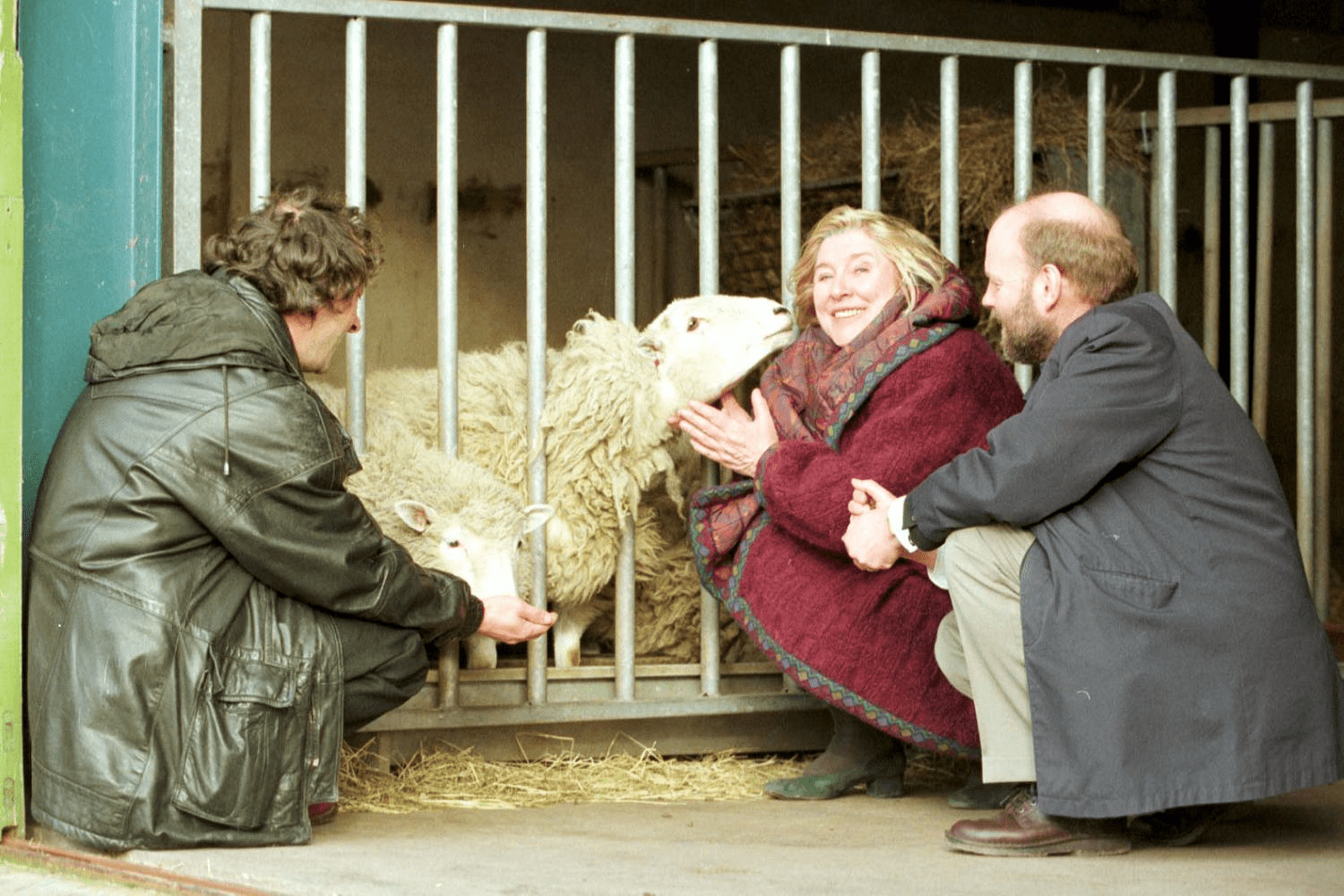
Researchers then transplanted nuclei from the passaged cells into oocytes (egg cells) from which the original nuclei had been removed. This process formed embryos, which were then implanted into surrogate sheep. As the lambs’ birth approached, Campbell and other team members took daily turns observing the sheep from midnight to 5 a.m. to ensure the pregnant ewes had no complications. The lambs, born in 1995, were named Megan and Morag. They were the first mammals cloned from cells taken from a differentiated cell line. Campbell successfully transplanted nuclei from differentiated embryonic cells because he discovered how to put these cells into a quiescent state (G0 phase). This quiescent state is not typically achievable in stem cells but can be induced in differentiated embryonic cells.
Wilmut attributed the experiment’s success to Campbell’s hypothesis: if nuclei were removed from differentiated embryonic cells in the G0 phase and transplanted into oocytes with high MPF, then differentiated embryonic cells could be cloned. Following the success of Megan and Morag, Campbell insisted that researchers could clone sheep using nuclei from fully differentiated adult cells, not just from differentiated embryonic cells. And he was right.
In 2008, Keith Campbell, Ian Wilmut, and Shinya Yamanaka of Japan received the Shaw Prize in Life Science and Medicine. Campbell died on October 5, 2012, at the age of fifty-eight.